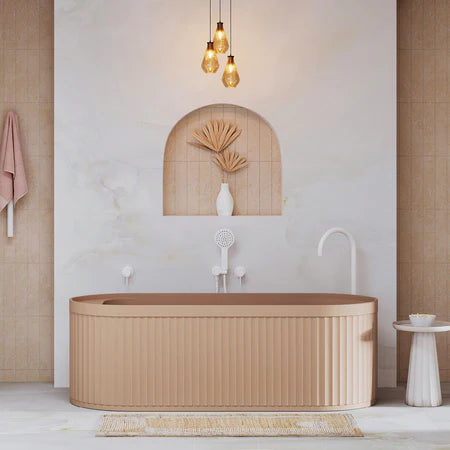


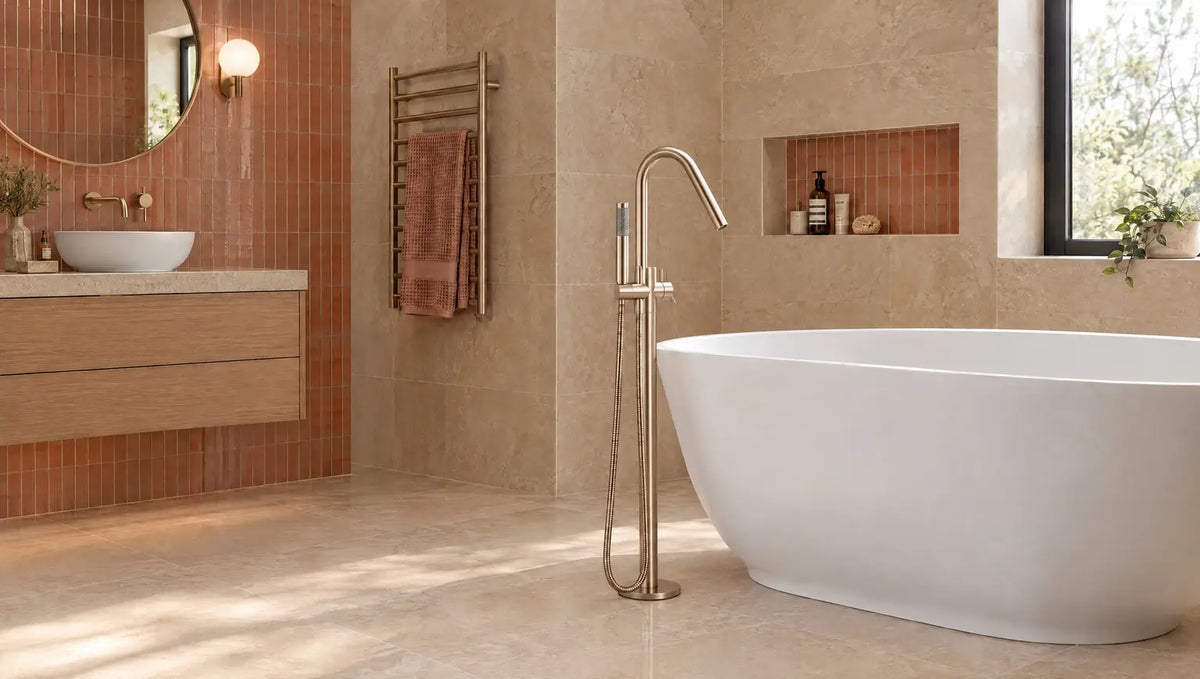
A freestanding bath is often the visual centrepiece of a bathroom, so its tapware needs to look considered from every angle. Freestanding bath fillers offer that sense of completion: a tall, sculptural fitting positioned beside the bath, rather than a tap mounted on a wall, hob or ledge. The right choice can reinforce a calm, hotel-inspired scheme. The wrong one can create avoidable plumbing changes, awkward reach or a finish that feels disconnected from the rest of the room.
For a renovation or new build, selecting a bath filler is about more than choosing a colour. Placement, water delivery, bath shape, rough-in requirements and ongoing cleaning all deserve attention before tiles are laid.
What are freestanding bath fillers?
A freestanding bath filler is a floor-mounted tapware assembly designed to fill a standalone bath. Most include a mixer handle and a swivel or fixed spout, while many also include a hand shower for rinsing the bath, washing hair or making bath time with children more practical.
Because the plumbing rises from the floor, this style works particularly well when the bath sits away from a wall or is positioned in front of a window. It also keeps the rim of a delicate stone, composite or acrylic bath clear of mounted tapware.
The visual appeal is obvious, but floor-mounted installation requires planning. The plumber needs to bring hot and cold water services through the floor at the correct location, then install the compatible in-floor body or mounting system before the finished surface is complete. This makes the selection an early project decision, not a final styling purchase.
Start with the bath position
The best bath filler placement is determined by how the bath is used and how the room flows. A filler generally sits alongside the bath, near the end where the bather can reach the mixer comfortably without stretching across the tub. It should not obstruct entry, compete with a shower screen or force someone to step around it in a tight room.
Check the bath manufacturer's recommended tap zone and measure the spout reach carefully. The water stream should land well inside the bath, rather than close to the rim where splashing becomes more likely. Deep baths and baths with thick rims can need a longer reach than expected.
Allow enough clearance for cleaning around the base. A bath placed very close to a wall may look efficient on a floor plan, but it can leave little room to wipe down the filler or access fittings if servicing is required. In compact bathrooms, a wall-mounted bath spout or a bath with deck-mounted tapware can sometimes be the more sensible option.
Think about the view from the doorway
Freestanding tapware is highly visible. From the bathroom entry, it can create an elegant vertical line that balances the volume of a curved bath or echoes the shape of a shower rail. For this reason, it suits bathrooms where the bath is intended to be seen, not tucked into a leftover corner.
If the filler will sit in front of a feature wall, window or vanity, consider its profile. A slim cylindrical design feels restrained in contemporary spaces, while a more detailed silhouette can support classic, coastal or heritage-inspired interiors. The aim is coordination, not necessarily matching every fitting exactly.
Choose the right configuration
A simple bath filler with a fixed spout suits households that only need to fill the bath. A model with a hand shower adds flexibility and is often worthwhile, especially in family bathrooms. It can make rinsing bath surfaces easier and offers a convenient secondary water outlet when needed.
A hand shower does introduce a few practical considerations. Look at where the hose sits when not in use and whether it will rest neatly against the tap body. Check that the diverter operation is intuitive, and make sure the hand shower and hose are finished to the same standard as the main fixture.
The handle position matters too. A single-lever mixer is familiar and clean-lined, allowing easy temperature adjustment. Separate hot and cold controls can suit more traditional schemes, though they create a more decorative look and may take slightly longer to adjust.
Water pressure should also be confirmed before purchase. Tapware has minimum and maximum operating pressure requirements, and performance can vary between homes. This is particularly relevant for properties using low-pressure systems, where a plumber should assess compatibility before installation.
Floor-mounted versus wall-mounted bath tapware
Floor-mounted freestanding bath fillers are the natural choice for a bath located away from walls. They create a complete, intentional look and preserve the clean exterior of a freestanding bath. Their trade-off is installation complexity: the floor rough-in must be accurate, secure and coordinated with waterproofing, tiling and any underfloor heating.
Wall-mounted bath tapware can be a practical alternative when the bath is close to a wall. It keeps the floor clear, can simplify cleaning and often costs less to install where wall plumbing is already planned. However, the wall position must be set precisely to achieve the right spout reach and height above the rim.
Neither option is universally better. A floor-mounted filler makes a strong design statement in an open layout, while a wall-mounted arrangement may be the more efficient choice in a narrow ensuite or renovation with limited access below the floor.
Select a finish that belongs in the room
Chrome remains a dependable choice for its bright finish, broad availability and easy coordination with existing fixtures. Brushed nickel and brushed gunmetal add softness and depth without dominating the space. Matte black provides contrast and definition, particularly against pale tiles, while warmer finishes such as brushed brass can bring character to natural stone, timber-look cabinetry and creamy palettes.
The most polished bathrooms use a deliberate finish story. That does not mean every item needs to be identical, but the bath filler should relate to the basin mixers, shower fittings, accessories and hardware. Repeating one finish throughout produces a calm, cohesive effect. Combining finishes can work beautifully too, provided it is purposeful - for example, brushed brass tapware with black lighting and mirror frames.
Consider maintenance honestly. Glossy chrome is forgiving with water marks, while darker and matte finishes may show mineral residue more readily in hard-water areas. Regular wiping with a soft cloth is usually enough to keep quality tapware looking its best. Avoid abrasive pads and harsh chemical cleaners, which can damage speciality finishes.
Get the technical details right before ordering
A beautiful filler is only a good purchase if it suits the installation. Confirm the overall height, spout height and reach against your selected bath, as dimensions vary significantly between designs. Ask whether the listed product includes the in-floor rough-in component or whether it must be ordered separately. This detail is easy to miss and difficult to resolve once work is underway.
Your plumber should review the installation instructions before rough-in. They can confirm pipe locations, floor construction, fixing requirements and service access. On upper levels, concrete slabs and timber floors may each require different preparation, so avoid assuming every floor-mounted model can be fitted in the same way.
It is also worth considering the sequence of your renovation. Ideally, the bath and filler are chosen before waterproofing and tiling, even if the visible tapware is installed later. Retain product documentation, finish details and model numbers with your project records. It makes replacement parts, future maintenance and matching accessories much easier.
Create a bathroom that feels resolved
A freestanding bath filler should support the bath rather than steal every bit of attention from it. Pair a sculptural curved bath with a refined, minimal filler for a quiet luxury look. With a classic slipper bath, a more traditional form can add appropriate detail. In a contemporary family bathroom, a hand-shower version in a durable finish can balance everyday function with a considered design outcome.
At Designer Bathware, comparing bath fillers alongside baths, basin mixers, showers and accessories makes it easier to see the full scheme, not just one isolated product. For renovation projects with fixed deadlines, expert advice before the plumbing stage can be as valuable as finding the right finish.
Choose the filler early, measure it against the actual bath, and let the plumbing plan follow the design. That small amount of planning is what turns a freestanding bath from a beautiful object into a genuinely enjoyable part of the room.